Total Pageviews

Wednesday, July 19, 2017

'N' is for Numbers . . .

"And Ruth the Moabitess said unto Naomi,
Let me now go to the field,
and glean ears of corn after him
In whose sight I shall find grace.
And she said unto her, Go, my daughter."
Ruth 2:2  KJV

‘N’ is for Numbers . . . it’s all about numbers!

Friends use numbers in place of names for the months of the year as well as for the days of the week. So, instead of saying today is Monday many (not all) Friends would say today is Second Day, and instead of saying June Friends would say Sixth Month.

This can be traced back to the use of numbers in the Bible – one example is when the women went to tomb, the Bible says they went on the First Day.

We talk a lot about other numbers . . . the number of members in the Monthly/Local Meeting and the Yearly Meeting. The number of members on committees – having enough members to get the work done, but not too many, enough so that no one member or group of members are overly burdened with too much work to do.

Numbers . . .

How many do we need for the program/event to go forward?

How many campers can we handle during any one week of camp?

How many campers will attend Adventure Camp?

How many Counselors and CIT’s (Counselor in Training) do we need for the week?

How many game stations will we need?

The use of numbers for the months and days of the week just happens and it only affects non-Quakers . . . trying to figure out what we’re talking about, sometimes.

A lack in the number of members in the Meeting or Yearly Meeting and/or in committees is a concern that we would spend time worrying over.

Another number that Friends might worry over would be how much money is in the treasury/bank account. How much money is coming in? How much is needed to cover our budget?

Many times we spend way too much time worrying about the numbers . . . not just as a faith body but personally as well.

Take a few minutes this week to think about all the numbers in your life and in the life of your Meeting/Church. How many of those numbers do you take for granted?

Just for fun . . . How many Quakers does it take to change a light bulb?


~ ~ ~ ~ ~ ~ ~ ~ ~ ~ ~ ~

Floral print with solid purple
made for my oldest daughter
‘N’ is for Nine-Patch . . . Traditionally, nine-patch was one of the first blocks taught to new quilters . . . and as it turns out, other than the quilt I made back when I was in college (embroidered blocks), the first quilt block I was taught, by a couple of the quilting Friends in my Meeting, was a nine-patch!

Very simply put a nine-patch is a block that consists of nine equal squares, with the squares sewn into three rows of three squares each. This quilt block is very traditional and versatile. You can make your squares, and thus your blocks, any size you want! Cut your squares 1.5-inches and make tiny 3-inch blocks . . . OR cut your squares 10.5-inches and make large 30-inch blocks!

Different patterns seem to immerge as you mix light and dark fabrics together and solids and prints. If using a larger print – you might ‘fussy cut’ those squares or use that print just in the center of your nine-patch. Nine-patch blocks are fun and easy to cut and make – there’s nothing difficult about them. Easy enough to piece by hand or machine – the choice is yours.

My first nine-patch block
As I said earlier, the first block I was taught was a nine-patch by some Friends in my Meeting that was during Vacation Bible School. Our Christian Education Committee thought it might be good to add some classes for the adults/parents to participate in (a way to increase our attendance). One of those classes was quilting. Each participant was given 18 squares of fabric – 9 print squares and 9 solid squares. We stitched them together by hand, which took a couple of days – even taking it home each night to work on it. After our two nine-patch blocks were stitched together, marked a quilting design in each of the solid blocks, basted the nine-patch to a piece of batting and then quilted the design. The two blocks were then hand-stitched together and stuffed to make a pillow. Well, I knew I had some of the print fabric in my stash at home and I decided I wanted to make two pillows instead of one and to use pillow inserts instead of batting. Well, I have my two nine-patch blocks quilted and ready for the backings . . . all I need to do now is to put my hands on the print fabric I have, which I’ve seen it a time or two over the years, and finish my two pillows.

Pair of nine-patch pillows
High School graduation gift to a friend

I’ve made several nine-patch pillows since, and given them away as gifts, these are usually 12-inch pillows – some just as is and some with borders and eyelet lace ruffles. As you can see, all of the nine-patches here use only two fabrics.


I’ve also made two quilts that have nine-patch blocks in them. You can check them out here:
and here:
Both of these are quilts I made for myself and use.

This post is truly ALL about numbers . . . 

Pair of nine-patch pillows
Graduation gift to a Friend


Friday, February 17, 2017

'M' is for Mission Statement . . .

"And Ruth the Moabitess said unto Naomi,
Let me now go to the field,
and glean ears of corn after him
In whose sight I shall find grace.
And she said unto her, Go, my daughter."
Ruth 2:2  KJV
 

‘M’ is for Mission Statement . . . I had been working on three totally different ideas for my “M” post when a fourth idea came to me during Meeting for Worship while visiting another Meeting recently when a member of that Meeting got up and spoke. This Friend talked about the need of having a Mission Statement. I got a scrap of paper out of my pocket and made a couple of quick notes for later as it hit me that this might be a better option for my “M” blog post. So here goes . . .
 
Most, if not all, businesses and organizations have a mission or purpose statement. That is a statement that lets others (the public) know who they are and what their purpose is in a nutshell, or brief statement, if you will. The mission/purpose statement will appear on printed materials, websites and the like. A mission or purpose statement can, and should be used, by a business or organization to keep themselves in check – something that they can refer to, as needed, to make sure they ARE doing what they say they will.
 
As the Clerk of Friends Committee on Scouting I’ve been asked several times over the years what our mission statement is. During our Annual Meeting in March of 2012 we reviewed and updated our committees’ Bylaws and while doing so renamed it Operations and Procedures. This included updating our Purpose Statement, which now reads:
 
Friends Committee on Scouting serves to encourage and promote the faith, history, and testimonies of the Religious Society of Friends (Quakers) through religious education programs for Quaker Scouts/Guides and other similar youth organizations. It does this through the development and promotion of:
 
·     Quaker Religious Awards for young Friends involved with Boy Scouts of America, Girl Scouts USA, Camp Fire USA, and other applicable American youth organizations, as the Committee may determine.
 
·     The Quaker Religion in Life Award for young Friends involved with Girl Guides of Canada and Scouts Canada.
 
·     Quaker resource material for faith-related badges for youth members of other Scout and Guide organizations throughout the world.
  
FCS also seeks to:
 
·     Inform Friends about Quaker Scouting/Guiding.
 
·     Represent the Religious Society of Friends (Quakers) to the various national and international Scout/Guide organizations throughout the world.
 
·    Serve as a networking opportunity for Friends involved in Quaker Scouting/Guiding Recognize adult volunteers with the various national Scout/Guide organizations throughout the world with the “Friends Emblem”.


A little closer look . . .
There are three more Quaker Mission/Purpose Statements that are part of my Quaker faith that I will also share here:

First from my Meeting, Mooresville Friends Mission Statement, as found on our monthly newsletter:
 
“Our Mission:  As members of the Religious Society of Friends, we believe that Jesus Christ can speak to the conditions of all people.  Mooresville Friends Church seeks to become a place of renewal, healing, comfort, and love in the community.   We exalt the Lord Jesus Christ, by reaching out and sharing the love of Christ with the wider community, equipping Christians to minister as members of God’s Kingdom, and encouraging Christians to live a victorious, spirit-filled life.”
 
Second from my Yearly Meeting, Western Yearly Meeting of the Friends Church Purpose Statement:
 
“Seeking the guidance of the Holy Spirit, Western Yearly Meeting equips Friends Meetings in the Gospel of Jesus Christ by exercising mutual care and extending cooperative ministries. Through various expressions of our Christian faith, we strive to inspire ministry and the release of gifts of leadership.”
 
And Third from Western Yearly Meeting Outreach Board, of which I am a member, I found the following mission/purposes listed in the 2016 Resource & Minute Book:
 
“This Board has two main duties. The first is to promote outreach projects throughout the yearly meeting. The second is to be good stewards of the assets we receive from our trust fund distributions.”
 
The Friend who spoke in Meeting for Worship went further than having a Mission/Purpose Statement for the corporate group and talked about having a Personal Mission Statement. An interesting thought to ponder.
 
We all have a mission in our lives, a purpose if you will, but I’m wondering how many of us, Friends or not, have ever sat down and really thought about what our mission or purpose in life is. How many of us have sat down, like a business or organization and put that mission or purpose down in writing? Sad to say that I’ve not done that . . . something to consider doing.
 
A Squirrel!
This last Wednesday when we returned to the Meeting House after lunch to continue sewing and quilting I looked up and saw something on the top of the Meeting House. What was it? We had recently had the roof replace, could the high winds have knocked some shingles loose? Looking a bit longer I realized that it was a squirrel! OK, not uncommon for squirrels to be up on the roof, but this one didn't appear to be moving. Was he/she stuck? Scarred? I had plenty of time to go into the Friendship House across the parking lot to grab my camera and take quite a few pictures. An hour or so later when I looked out the window this little squirrel was gone. But as I got ready to publish this post I was looking for pictures, and these came to my mind as they seemed to fit. As I said above, we all have a mission in our lives . . . so did/does this squirrel! If nothing more than to make us pause for a bit Wednesday to wonder 'What is that up there?' and then to wonder 'Is he/she stuck/scared?'
 
Think about it. What is your mission or purpose in life? Is it to make others pause for a bit and wonder 'What's up?' OR 'Am I stuck/scared?'  God knows what it is, but do you?
 
Writing this has reminded me of a song that we taught the students in Weekday Religious Education classes (third and fourth graders) “God Has a Plan”:
 
“God has a plan for you and me:
Only He knows what we can be
Follow His teachings and learn to trust
God has a plan for us.”


~ ~ ~ ~ ~ ~ ~ ~ ~ ~ ~ 


2012 'Monkey
Wench' block
‘M’ is for Monkey Wrench . . . same name – different look. Monkey Wrench is another one of those quilt blocks that isn’t just one block – that is our quilting group at Mooresville Friends Meeting has made Monkey Wrench quilt blocks twice but they have totally different looks to them.

2016 'Monkey
Wrench' block
Monkey Wrench is one of the quilt blocks that is said to have been used in quilts used along the Underground Railroad here in the United States. Either alone or in a quilt with blocks of many patterns, it was a sign to the slaves to gather the tools they would need for their journey to freedom. Tools that could be used to build shelters, help determine direction, used as weapons to defend themselves (such as a Monkey Wrench), etc.


Who would have thought that I could talk about squirrels and monkeys in the same blog post and have it make some sense????


Wednesday, January 18, 2017

'L' is for Library . . .

"And Ruth the Moabitess said unto Naomi,
Let me now go to the field,
and glean ears of corn after him
In whose sight I shall find grace.
And she said unto her, Go, my daughter."
Ruth 2:2  KJV
 
Children's books
‘L’ is for Library . . . A collection of books, videos, magazines, pamphlets and other materials. A library is a resource full of information as well as a source of materials for pleasure.
 
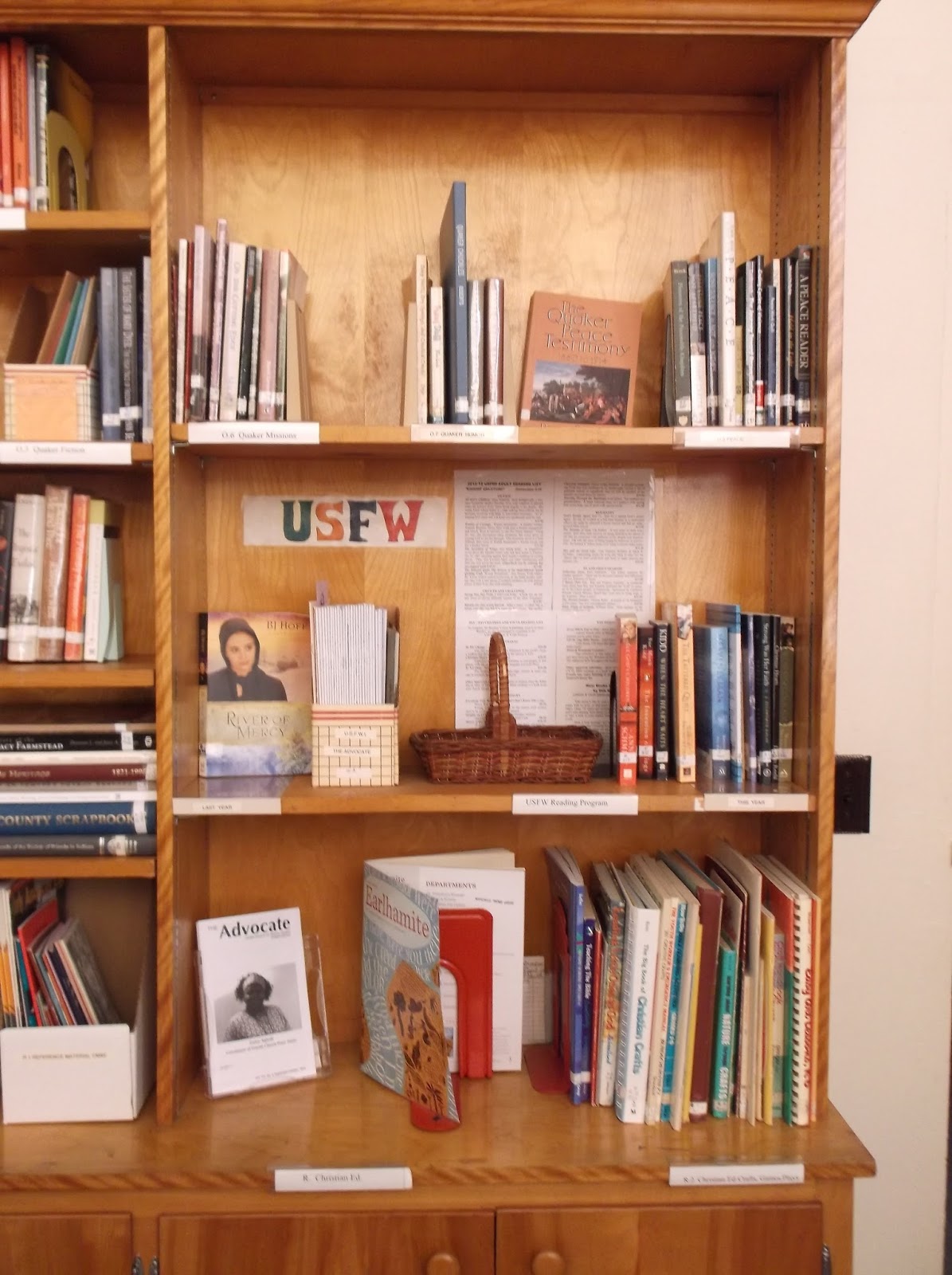
Mooresville Friends Meeting and I’ll assume that most Meetings and Yearly Meetings have a library full of resources available to its members. Our library has materials for all our members and visitors – from the wee Friends up to the oldest of Friends.
 
Since I started attending Mooresville Friends Meeting we’ve had two or three members of the Meeting that have served as our Librarian and when we did a bit of remodeling the library moved into the old nursery. Friends and visitors entering through the back door of the Meetinghouse walk through the library on their way to the sanctuary and the rest of the Meetinghouse.


The books and tapes in my Meetings’ library are shelved and labeled as they would be in a public library. We don’t have a ‘card catalog’ but there is a book with all the materials listed and their ‘call number.’ Along with all the printed books we have books on tape, videos for all ages, Christian Education materials and bound copies of our Meetings’ minutes from 1823-2013.

USFW books
One shelf is dedicated to USFW (United Society of Friends Women) Reading list books. A variety of books from the current year’s list and those from the previous year are on the shelf. Women of the Meeting are encouraged to check out these books, read them and then check off which ones they’ve read on the USFW reading chart, located on one of the walls in the library. Those that complete the requirements, that is, read the designated number of books, receive a certificate at the end of the year.

USFW Reading Chart
I’m not much of a reader, I blame it on several junior high, high school and college teachers who forced me to read books that I wasn’t interested in, but I found several books on the reading list the last couple of years that sounded interesting and I read them. The Fall of 2015 I received my very first certificate and in 2016 I received my second! Need to get busy reading for this year!
 
A few years ago our Librarian, with the help of a few other Friends, acquired a software program and cataloged our collection – last year that software was replaced with a newer program with another.
 
 
~ ~ ~ ~ ~ ~ ~ ~ ~ ~ ~ ~

Log Cabin Block
‘L’ is for Log Cabin quilts - a rather simple block made with a square and strips of fabric.
 
The history of the log cabin quilt pattern is not easy to track down as it has a very long history and not everyone agrees with it, however the pattern itself is easier to explain.

The basic log cabin quilt block begins with a square around which the quilter sews strips of fabric around the sides in sequence. This sequence varies depending on the effect the quilter is going for. Normally light and dark fabrics are alternated. A quilter may carefully plan out her log cabin quilt or make it scrappy.
 
Folklore will tell you that tradition is that the center square is red – it was believed that it stood for the hearth of the house – as told by quilters in the late 1800’s. The strips of fabric around this center square alternate light and dark – representing the sunny and shaded sides of the house. Others believe that the light strips represent happiness and the dark sorrow, of which lives are full of.
 
Quilters began sewing log cabin quilts in the United States since the 1860’s. They were popular during the Civil War – being sold and auctioned to raise money for the troops.
 
Other popular names for log cabin quilts are - barn raising, court house steps and sunshine and shadows.

Traditionally log cabin quilts are sewn by sewing the ‘log’ strips around the center square. The ‘logs’ vary in size and round by round may vary in width as well. Many quilters will piece their log cabin blocks/quilts onto a foundation fabric. I found I couldn’t keep my ‘logs’ from stretching out of shape on their own, so I use the foundation or paper piecing method to make mine.
 
Many stories of the Underground Railroad will tell you that the log cabin block was used to in the quilts as signals to the slaves escaping to the North and that the color of the center block was important in that. In Stitched from the Soul, Gladys-Marie Fry suggests that a log cabin quilt with black centers, hanging in front of a house indicated that it was a safe house. Traditionally the center block was red, which was said to represent the hearth or fire of the cabin. A yellow center was said to indicate a light or beacon in the wilderness – William Lloyd Still, a famous black Underground Railroad conductors’ log cabin quilt had a yellow center. One thought was that a log cabin quilt hanging outside of a home indicated that it was a safe house. Another thought was that it might have been a signal to the runaway slaves to build a log cabin to weather out the winter or establish residency in a free area.
 
The log cabin pattern has only been quilted with fabric for about 200 years. It is believed that British pioneers brought the pattern with them to America and that the Amish brought it with them from Germany.
 
Alex's Log Cabin Pillow
I made this log cabin pillow for Alex, the first grandchild, of my college roommate (sophomore year) when he was born in 2008. My roommate & her husband had built a log cabin home many years earlier and I used that as my inspiration for Alex’s pillow. Alex battled many tough battles during his short life and if memory serves me right he lived less than a year.
 
In part the inscription on the inside of Alex’s pillow mentions “his grandparents’ log cabin house as my inspiration for his pillow and that it’s a strong foundation and family. I also explained my color choices – Red ~ traditional center, brings thoughts of your heart (he had heart issues); Yellow ~ youth birthstone (yellow topaz) and how you shine; Blue ~ because you’re all boy! I arranged the 4 blocks in this way as it framed a bright cross in the middle, a reminder of all the prayers said for you.”
 
I hand pieced and quilted this pillow and as I worked on it I continually prayed for this special little boy.
 
I was able to go to the visitation for Alex, surprised his grandparents when I walked in, as I wasn’t sure if I’d be able to get there or not and much to my surprise the pillow I had made and given to Alex was there.
 
~ ~ ~ ~ ~ ~ ~ ~ ~ ~
 
When I thought about writing this post I knew I wanted to include the log cabin block and a picture of the pillow I had made for Alex ~ and I got frustrated when I couldn’t find any of the pictures of this pillow for my blog. I found it this week – on my old external hard drive.


Friday, February 12, 2016

Friendly Greetings From Around the World/Saludos de amistad de todo el mundo . . .

"And Ruth the Moabitess said unto Naomi,
Let me now go to the field,
and glean ears of corn after him 
In whose sight I shall find grace.
And she said unto her, Go, my daughter." 
Ruth 2:2  KJV
 
(Ver la traducción española de abajo.) 
 
Friendly Greetings From Around the World . . . the quilt blocks made and displayed during the recent FWCC World Plenary in Pisac, Peru.
 
In my previous post, "Quilt Block Project" I shared about the two quilt blocks that I made for this project. In this post I will share the information that we were given about the project and photos I took of many of the quilt blocks that were made by other Friends.
 
In November we were invited to 'bring creative greetings' from our home Meeting - that is to bring greetings on a piece fabric, which would be displayed during the Plenary, and we'd be able to take a greeting home with us from another Friend.
 
Simple instructions were provided for making our greeting:
Step 1: find a piece of plain cloth (material) 30cm by 30cm (OR 12-inches by 12-inches);
Step 2: write on the fabric and decorate it however you like;
Step 3: you can sew pictures on or glue pictures on to the fabric;
Step 4: keep it simple or make it very fancy if you like;
Step 5: ask Friends from your meeting or church to help you;
Step 6: add tabs to each corner;
Step 7: put it in your suitcase when you come to Peru.
A photo example was included of a very simple greeting on a piece of cotton fabric with the greeting written with a permanent marker and pictures/pieces of printed fabric and tabs glued on.
 
The quilt blocks at the Plenary were as different as each Friend in attendance. Not all Friends made quilt blocks but quite a few did. Some blocks were very simple - keeping with the Quaker Testimony of Simplicity maybe??? Others much more complex. Many were 30cm by 30cm (12-inches by 12-inches) as per the instructions given . . . while some were smaller and others quite a bit larger. Others were written on pieces of paper.
 
Choosing which quilt blocks I would bring home with me was quite challenging . . . and I'll not disclose here which quilt blocks I chose to bring home as I have a special project or two in the works which will include those quilt blocks along with the duplicates of the quilt blocks I made and took to the Plenary.
 
I'm not quite sure yet whether all four quilt blocks will be put together into one piece OR if I'll make two pieces - one with the greeting I made from Mooresville Friends Church and the greeting I chose in exchange for that one and a second piece with the greeting I made from Friends Committee on Scouting and the greeting I chose in exchange for that one. Either way, I plan to have that all done before Western Yearly Meeting sessions in mid-July 2016 and to display it/them during Yearly Meeting. Which means I've got a bit of work to do!
 
I've not included photos of ALL the quilt blocks that were made, as that would have taken up a lot more room - I may share others in future posts.


"And Ruth la moabita dijo a Noemi, 
déjame ir al campo y recoger mazorcas
de maíz después de él en cuyos
ojos voy hallar gracia.
Y ella le dijo, vaya, mi hija."
Rut 2:2 KJV
 
Saludos amistosos de todo el mundo. . . los bloques de acolchado hacen y se muestran durante el reciente Mundial del CMCA Plenaria en Pisac, Perú.

En mi post anterior, "Proyecto del bloque del edredón" Me compartió acerca de los dos bloques de edredón que he realizado para este proyecto. En este post voy a compartir la información que nos dieron sobre el proyecto y las fotos que tomé de muchos de los bloques de acolchado que fueron realizados por otros amigos.


En noviembre fuimos invitados a 'llevar las felicitaciones creativas' de nuestra reunión en casa - que es para llevar las felicitaciones en una tela pieza, que se muestra durante la Plenaria, y nos gustaría ser capaz de tomar un hogar de felicitación con nosotros de otro amigo .
 
se dieron instrucciones simples para hacer que nuestro saludo:
Paso 1: encontrar un pedazo de tela de 30 cm sin formato (material) por 30 cm (o 12 pulgadas por 12 pulgadas);
Paso 2: escribir sobre la tela y decorar como quieras;
Paso 3: se puede coser o pegar imágenes en cuadros en la tela;
Paso 4: que sea sencillo o lo hacen muy elegante si lo desea;
Paso 5: pedir a los amigos de su reunión o iglesia para ayudarle;
Paso 6: añadir pestañas para cada esquina;
Paso 7: ponerlo en su maleta cuando se llega a Perú.
Una foto de ejemplo se incluye de una manera muy simple saludo en un pedazo de tela de algodón con el saludo escrito con un marcador permanente y fotos / piezas de tela impresa y pestañas pegadas sucesivamente.

 
Los bloques de edredón en el Pleno eran tan diferentes como cada amigo en la asistencia. No todos los amigos hechos bloques del edredón, pero muy pocos lo han hecho. Algunos bloques eran muy simples - consonancia con el testimonio del Quaker de la simplicidad tal vez ??? Otros mucho más complejos. Muchos eran de 30 cm por 30 cm (12 pulgadas por 12 pulgadas) conforme a las instrucciones dadas. . . mientras que algunos eran más pequeños y otros un poco más grande. Otros fueron escritos en pedazos de papel.

La elección de las cuadras colcha Me gustaría llevar a casa conmigo fue todo un reto. . . y yo no voy a revelar aquí que bloquea edredón he elegido para llevar a casa ya que tengo un proyecto especial o dos en las obras que incluirá los bloques de acolchado junto con los duplicados de los bloques de acolchado que hice y se llevó a la Plenaria.
 
No estoy muy seguro todavía si los cuatro bloques de edredón se ponen juntos en una sola pieza o si voy a hacer dos piezas - uno con el saludo que hice de amigos Iglesia Mooresville y el saludo elegí a cambio de que uno y una segunda pieza con el saludo que hice de Comité de Amigos sobre el Movimiento Scout y el saludo elegí a cambio de que uno. De cualquier manera, planeo tener todo hecho de que antes de las sesiones de la Junta Anual occidentales a mediados de julio de 2016 y para mostrar / ellos durante la Reunión Anual. Lo que significa que tengo un poco de trabajo que hacer!

No he incluido fotos de todos los bloques de acolchado que se hicieron, ya que hubiera tomado las mucho más espacio - me permite compartir otros en el futuro puestos.